Grateful to God Who Has Protected Me in Every Great Crisis
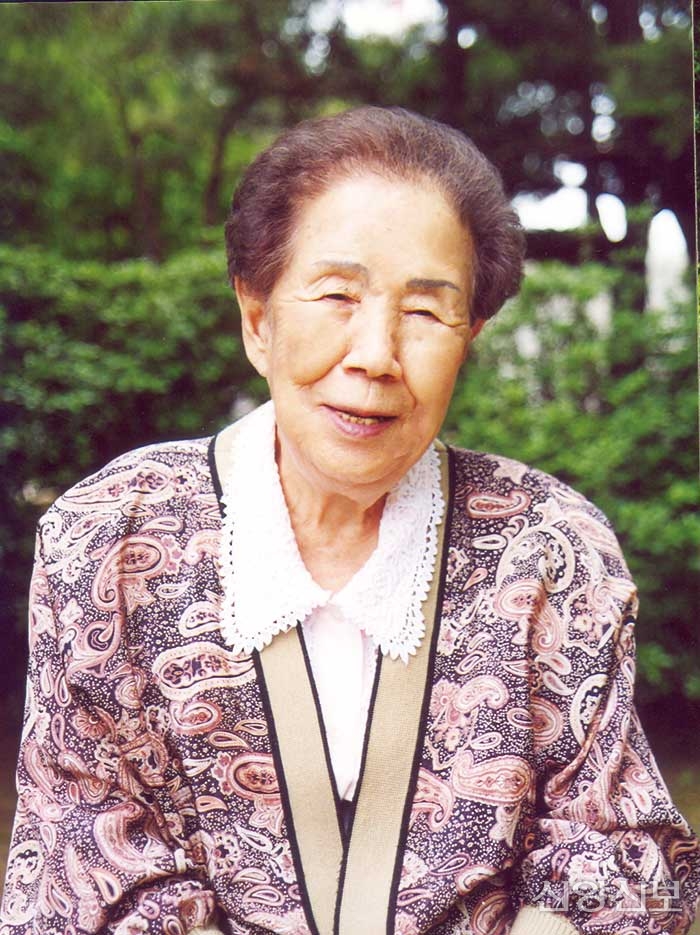
안음전 승사
The reason I first came to follow God was because of an unforgettable and precious experience of gratitude.
In 1950, my family lived in Palpan-dong, Jongno-gu, Seoul. My husband owned a small transport business with two trucks and four employees. That year, the Korean War broke out, and our family fled to Yangpyong where relatives lived. After some time we returned home, trying to settle back into life. But as soon as the news came that the North Korean army was advancing again, people around us began to flee once more. It was during what came to be called the January 4th 1951 Retreat. Our family also belatedly packed and set out on the path of refuge.
When we crossed the frozen Han River and reached the Noryangjin area, we saw a long freight train standing on the railway. The train had no roof and only low wooden bars along its sides. Many people were climbing aboard, desperate to escape. Someone told us that to survive we had to take this train to Busan. Hearing that, my family also forced our way in, placing our luggage and handcart on board and sitting on the floor.
At that moment, soldiers came and took my husband off the train to dig an air-raid shelter, while I remained with the children. Soon a tall and dignified-looking gentleman called out to me, “Mother! Mother of the children!” In that chaotic scene, people were carrying or dragging bundles, but this man looked different—he wore a fresh white shirt, a necktie, a light-colored coat, and a fedora. I asked why he was calling me. He told me, “Do not stay on this train. Get down, please.” I protested, saying, “Who are you to say so? We fought to get on this train because they said only by taking it to Busan can we survive. How can we get off now?” But he earnestly repeated, “Please listen to me. You must not take this train. You cannot.”
When I asked what we should do, he climbed onto the train, lifted down our four children, our luggage, and even the handcart, and placed them on the ground, and reloaded our luggage onto the handcart. He then asked where the children’s father was. I pointed toward where my husband was working with soldiers. The gentleman went there, spoke with the soldiers, and brought my husband back. He then pushed the handcart and guided us across the tracks. He told my husband not to follow the military road to Busan but instead to hide away in the countryside and return when the war calmed down. After helping us, he disappeared so quickly that when we turned back, he was nowhere to be seen.
As night fell quickly, we could not go far and had to find a place to stay for the night. We came upon an empty pigsty along a country road. Since it was piled with rice straw, we spread it out, laid our blankets on top, and rested our weary bodies. After some hours, the sound of bombing came from afar, followed by a village broadcast. It announced that the very train we had almost boarded was bombed and that all on board had perished. My husband and I were stunned. We ran outside and saw in the distance the train burning in flames. At that moment, the image of the gentleman who had so earnestly urged us to leave the train filled my mind. I thought, “That man saved our whole family!” My heart overflowed with gratitude.
Since that day, not knowing where to go, we simply followed the crowd of refugees. While we were climbing a path that led over Mt. Gwanak, I was carrying a child on my back and pushing our handcart uphill. Exhausted, I briefly closed my eyes, and before me appeared the very gentleman who had once saved our family. He said to me, “Do not stay here. Move over to the side.”
Startled, I opened my eyes and told my husband that we should move to another spot. But he dismissed my words, saying the place we stood was good enough and that I was speaking nonsense. Still, I insisted we should move, urging my children to push the handcart down to a slightly lower place.
As soon as our family gave up our spot, another family quickly took it. Moments later, a military truck suddenly veered into that place, and the family tumbled down the cliff. In the chaos of the refugee procession, the soldiers had mishandled the truck, striking them. Just minutes earlier, it had been the very place where my family was walking. The thought alone chilled me to the bone. Thus, once again, by the help of that gentleman, our family narrowly escaped a great danger and preserved our lives.
During the Korean War (6·25), we were on a train bound for Busan when a gentleman
earnestly advised us to get off, and by following his words, our family’s lives were spared.
As we heeded the words and moved aside, we avoided a military truck accident.
At the Namsan gathering, I finally met God, whom I had been searching for, and began to follow Him.
I am endlessly grateful for God’s grace that has guided me to this day.
After that, together with other refugees, our family settled in Namyang-myeon, Hwaseong-gun, Gyeonggi Province. My husband opened a photo studio, while I made a living selling clothes. I always longed to meet once again the gentleman who had saved our family twice during the war, but I had no idea where I might find him. I wondered if perhaps he was a churchgoer. So, as I traveled to various towns for my trade, I would attend church services whenever I saw a church, hoping that he might be there. I also faithfully attended the Methodist church in Namyang-myeon and was so zealous for revival meetings that people sometimes thought I was excessive. Whenever a revival meeting was held, church members often let me know, knowing how eager I was to attend.
Then, one day in March 1955, late at night, the leader of our church cell group visited me and said, “I went to Seoul on some business, and while there, I heard of a gathering being held at Namsan, so I attended briefly.” He told me that at the Namsan meeting, a young gentleman, neatly and modestly dressed, was leading the hymn singing, and during the worship a mist-like presence descended while a fragrant aroma filled the air. He also said that many people had gathered there. When I asked where it was, he said that there was a meeting place at the top of Namsan, and that the gathering would not last much longer. After hearing this, I was so eager to go that I could hardly sleep that night. The next morning, carrying my twenty-day-old baby on my back, I boarded the first train to Seoul. A few hours later, I arrived in Seoul and began climbing the steps of Namsan. As I went up, an astonishingly pleasant fragrance filled the air. Even as I entered the crowded meeting hall where people were gathered, that wonderful aroma continued to pour forth. On the floor of the hall, straw mats were spread out, and many people sat closely packed together, among them many who were sick. While I was still searching for a place to sit, my older sister’s son—spotted me from the front. Later I learned that my two older sisters had just been saying, “Since Eum-jeon eagerly attends revival meetings, she will probably come here too if she finds out.”
Some time later, a man walked up to the podium. I thought the service was about to begin and looked at him, and I could not help but be utterly astonished. The man was none other than the gentleman who had saved my family during the war. Words cannot express how overjoyed I was to finally see the person I had been searching for. He led the singing of Hymn No. 418, “The Lord who takes up our sins.” As the congregation clapped their hands and sang along, I joined in, clapping and singing. My heart was so full of joy that I felt as if I could fly. The fragrant aroma continued to fill the air, and my entire body felt refreshingly uplifted. It was at this Namsan gathering that I encountered God again, and from that moment, I began to follow Him.
After the Namsan meeting, I stayed for a few days at my elder sister’s house in Wonhyo-ro, attending early morning services with her. At that time, my two sons were living in Seoul for school, so I often came up to Seoul, and each time I did, I would go to services in Wonhyo-ro with my sisters. Since I was not attending the church I had previously gone to, the pastor, elders, and deacons of that church would come and scold me. Nevertheless, my heart kept turning toward Wonhyo-ro, and I went to Seoul more frequently.
After Twenty Thousand Altar (the Chunbukyo Church with the seating capacity of 20,000) was built, I attended services there.
A few years later, I heard that there were church members in Namyang-myeon, and a missionary from Chunbukyo Church came to visit our home. From that time, we rented an empty room and began holding worship services. During this period, God sent slate and cement through the missionary, instructing us to build Chunbukyo Church. However, with no land on which to build, I could only pray tearfully to God every morning during the early morning service, feeling a heavy heart. Seeing my concern, my husband, who did not yet believe in God, willingly secured land for Chunbukyo Church. The missionary and the minister of the Anyang Chunbukyo Church came to start construction. Though many difficulties arose during the building process, the church was completed safely.
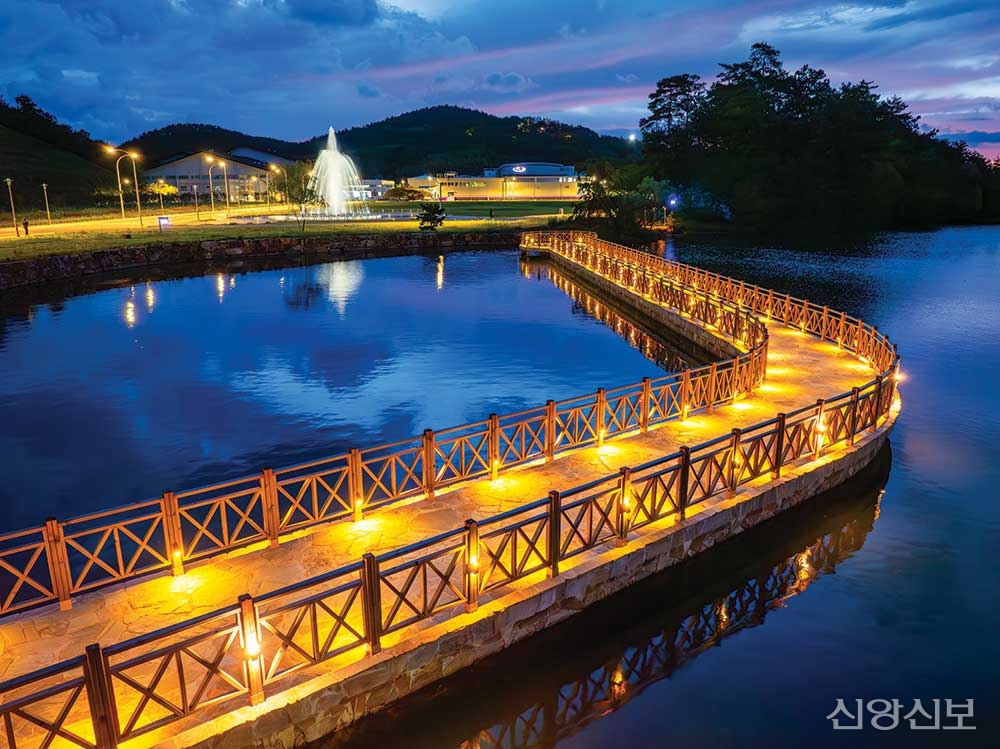
신앙촌 식품단지 풍경
I used to attend the Namyang Chunbukyo Church, but in 1982, at the invitation of my eldest daughter who was in New York, I emigrated to the United States. Before leaving, I asked the minister, who told me that there was also a Chunbukyo Church in New York. However, immediately after arriving, I could not find the church. After about three months of struggling with this, I learned about someone who attended a Chunbukyo Church through a neighbor, and from then on, I began attending the New York Chunbukyo Church.
While attending the New York Chunbukyo Church, by God’s grace, I was able to directly see and experience how the bodies of the deceased would bloom beautifully. Among these experiences, two individuals remain most memorable to me. One was Lee Jung-hee, the younger brother of Lee Soon-i, Seungsa at our church, who passed away from stomach cancer in 1993. He had been a devoted attendee of the church during his life. On the day he was laid in the funeral hall, we held a service with the congregation that evening and I saw that his appearance was even more radiant and beautiful than it had been during his life. His lips were red, and his nails had a delicate color, as if dyed with balsam flowers. Some even said that his two hands were joined together and that light seemed to shine between his fingers as if he were holding a bulb.
Also, in June 1999, when Lee Yu-soon, Seungsa at the New York Chunbukyo Church, passed away, her face appeared radiant and soft, unlike the many age spots she had in life, and she departed peacefully with a gentle smile.
By God’s grace, I have lived until this day. Looking back, I realize that too often I acted according to my own circumstances rather than with a heart of obedience. Yet God poured His precious grace upon me and guided me all the way. For this, I give my boundless thanks.
<Published on Sept. 23 & 30, 2001>